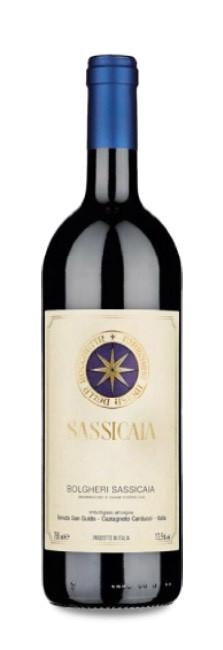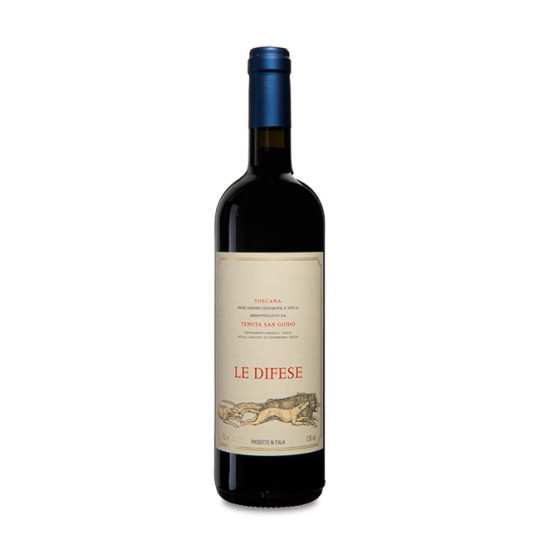


Sassicaia is regarded as the first Italian wine to gain international acclaim.
It is hard to believe that this country, with centuries of winemaking tradition and history, had not produced wines of this calibre until the 1920s, when the marquis Mario Incisa della Rocchetta harboured a dream: to create a "thoroughbred" Italian wine following Bordeaux ideals. He ultimately succeeded in crafting this red wine from the Tenuta San Guido estates in Tuscany, specifically in the Maremma Italiana. This consistent excellence, recognised in some vintages with 100 Parker points, has earned it its own DOC: DOC Bolgheri Sassicaia.
There, on soils with alluvial deposits (where silt, clay, sand, gravel, and a high concentration of iron and manganese intermingle), lie the 2,500 hectares owned by this winery, divided into three areas: the marshes, the plain, and 75 hectares of vineyards. In these latter plots—situated on the rear hill of Bolgheri—the old vines (with their deep-rooted systems) grow at an altitude of 400 metres, influenced by cool nights and dry, hot summers. As for the cultivated varieties, the undisputed queen at Tenuta San Guido is cabernet sauvignon, the only grape that, after several experiments, proved to impart the same bouquet as an aged Bordeaux.
This detail marked a revolution and a break from the local tradition, where until then only sangiovese and nebbiolo were vinified, producing fresh red wines. The critics, who expected to find that profile, did not understand the proposition made by the marquis Mario Incisa della Rocchetta with Sassicaia, overlooking the fact that cabernet sauvignon wines needed time to mature and evolve. For this reason, between 1948 and 1967, the consumption of Sassicaia remained confined to a completely private sphere, among the marquis and his aristocratic friends, until during one of these private tastings, upon uncorking the bottle, the optimal evolution of Sassicaia was discovered. Thus, in 1968, it began to be marketed, considered the father of the Super Tuscans, a group of wines that in the 1960s forever changed Italian wine.
Today, as it celebrates its 50th anniversary, no one doubts its magnificence, the result of meticulous production that begins with manual harvesting and the selection of the finest berries on a sorting table. This care and diligence continue in the gentle destemming and crushing, to avoid breaking or damaging the skins. From there, the must is placed in stainless steel tanks, where it ferments separately with indigenous yeasts at a controlled temperature between 28°C and 30°C. The macerations, where all the character, colour, and aromas are imparted to Sassicaia, cannot be overlooked. This process, where the wine remains in contact with the grape skins, lasts between 11 and 12 days and is accompanied by other actions, such as pump-overs or délestages (a process of transferring the wine from one tank to another, leaving the cap inside, and then returning the wine to the original tank, breaking up the mass of skins). Finally, Sassicaia is rounded off with a spontaneous malolactic fermentation in stainless steel tanks. After this, Sassicaia is transferred to French oak barrels (one-third new wood and the rest, first and second use) sourced from the forests of Allier and Tronçais, where it rests for 24 months of ageing. The blending and final touch are carried out a month and a half before bottling, where it will eagerly await a brief period before being marketed.