


 Red wine
 White wine
 Rosé wine
 Wines in Primeur
 Sherry and Port wine
 Sweet wine
 Orange wine
 Vermouth
 Champagne
 Cava
Cava Prosecco
 Lambrusco
 Crémant
 Moscato d'Asti
 Franciacorta
 Pet-Nat
 Corpinnat
 Other sparkling wines
 Rhum
Rhum Gin
Gin Whisky
 Vodka
Vodka Cognac
 Brandy
 Pastis
 Tequila
 Mezcal
 Grappa and Eau de vie
 Calvados
 Liqueurs
 Pacharán
 Apéritifs
 Wine gift boxes
 Boxed wines
 Boxed sparkling wines
 Wine bottles and glasses
 Gift card
 Non alcoholic Wine
 Non alcoholic Sparkling wine
 Aromas
 Wine conservation
 Decanters and aerators
 Bottle identifiers
 Corkscrews
 Service
 Glass identifiers
 Cleaners
 Accessories set
 Wine glasses
 Contact

Unveiling Pedro Ruiz Aragoneses, CEO of Alma Carraovejas
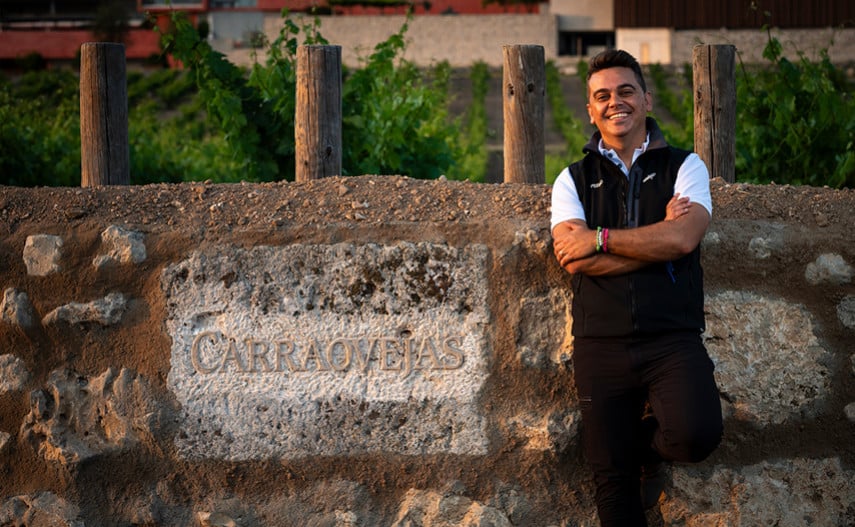
It all began with the need to complement a table, a family tradition, and a way to welcome the world... Thus, Pago de Carraovejas was born. With a very specific idea of creating the perfect wine to accompany the suckling pig at the family restaurant José María, in Segovia. The restaurant was the grand showcase, but also the heart of the project.
Today, nearly four decades later, the project spearheaded by Pedro Ruiz Aragoneses has evolved into a broad, diverse, and esteemed group within contemporary Spanish wine under the brand Alma Carraovejas. Yet, one thing remains unchanged: the passion for doing things with purpose, identity, and meticulous attention to detail.
A Family Project Turned Collective Dream
Pedro Ruiz Aragoneses always speaks in the plural. “We are,” “we do,” “we believe”. Never “I”. This manner of expression encapsulates much of the project: a collective endeavour.
He is the fourth of five siblings. All of them spent time at the family restaurant, but he was the only one who felt a special connection with the winery in Peñafiel, accompanying his father as a child. In 2007, he officially joined the company and today serves as CEO and managing director, although he downplays the titles. “My job is to define where we are going, how we are going, and how we will do it. But we are a wonderful team. It is a shared dream.”
The culture of detail, the internal structure, and the care of each process are essential pillars of the project. “The team is the heart,” he repeats. Not as a slogan, but as a genuine understanding that each wine is the sum of many perspectives.
From Psychology to Wine
Wine was not his first calling. Pedro studied psychology and asserts that discovering systemic psychology in his third year of university changed his life. This discipline, which examines how individuals relate within systems such as families or organisations, ultimately shaped his approach to the family business.
Before taking on responsibilities at the winery at just 24 years old, he had already worked with the Red Cross, run his own practice as a family and couples therapist, worked in child protection, taught at university, and collaborated with social associations in Segovia.
So when he joined the company, he admits with a laugh, “I didn’t even know how to read a balance sheet.” “But the important thing is to listen a lot.” This ability to listen, more akin to a therapist than a traditional executive, was crucial in leading a project about which he knew little technically, but with which he connected deeply on a human level: learning before imposing, observing before deciding.
From Crianza to Estate Wine
The major turning point came in 2015, when the project abandoned the classic logic of crianzas and reservas to embrace the concept of estate and parcel wine at Pago de Carraovejas.
Travelling, tasting, and opening their eyes to other regions led to the conclusion that the focus should be on the origin, not the time in the barrel. The landscape, not the technique.
“There were two options in the face of scarcity: grow in volume or grow in quality. And we were clear about it,” Pedro recalls. It was a bold decision at a time when the market still demanded the usual wines.
The change involved more complexity, more study of the terrain, and higher costs, but also a much more defined identity. Thus, Pago de Carraovejas was solidified as an estate wine, redefining the message, the label, and the way of understanding the project. “We think more about the customer ten years from now than the one from ten years ago.”
Perhaps the easiest path would have been to continue growing on what was already established, but for Pedro, “things need to be addressed when they are working. When they stop working, it’s already too late.”
This idea permeates the entire project. Never settling, even when everything is going well. “Carraovejas used to be a wine that everyone liked. Today we seek something else: wines with identity, vibrancy, texture, that speak of the place.” Because wine, like the project itself, is not a closed formula, but a living process.
The Identity of the Landscape
Pedro’s discourse always returns to the territory. To the vineyard. To the landscape as the origin of everything.
Today, the work in the field is meticulous. Each parcel is studied, each soil interpreted, each wine conceived as a translation of the place from which it originates. Climate change has also necessitated rethinking varieties and strategies, with particular attention to garnacha, a local variety regaining prominence. “For years it wasn’t valued, but it has enormous potential,” he notes.
The group now integrates projects in various wine-growing regions of Spain, but they all share an essential condition: a vineyard with identity and a landscape capable of evoking emotion. These are not sought-after projects, but rather discovered ones.
This entire philosophy reaches its culmination upon crossing the threshold of Ambivium, the group’s restaurant next to the winery, boasting a Michelin Star and a Green Star.
There, wine does not merely accompany the experience; it directs it. Among rooms dedicated to wine, a cellar with over 5,000 references, and a menu that speaks of territory and memory, the experience becomes a way of understanding the world.
And perhaps that is why everything fits. Because in the end, everything began at a table. And everything, in one way or another, continues to return to it.