


 Red wine
 White wine
 Rosé wine
 Wines in Primeur
 Sherry and Port wine
 Sweet wine
 Orange wine
 Vermouth
 Champagne
 Cava
Cava Prosecco
 Lambrusco
 Crémant
 Moscato d'Asti
 Franciacorta
 Pet-Nat
 Corpinnat
 Other sparkling wines
 Rhum
Rhum Gin
Gin Whisky
 Vodka
Vodka Cognac
 Brandy
 Pastis
 Tequila
 Mezcal
 Grappa and Eau de vie
 Calvados
 Liqueurs
 Pacharán
 Apéritifs
 Wine gift boxes
 Boxed wines
 Boxed sparkling wines
 Wine bottles and glasses
 Gift card
 Non alcoholic Wine
 Non alcoholic Sparkling wine
 Aromas
 Wine conservation
 Decanters and aerators
 Bottle identifiers
 Corkscrews
 Service
 Glass identifiers
 Cleaners
 Accessories set
 Wine glasses
 Contact

Introducing Verónica Ortega, the Andalusian winemaker who loves El Bierzo
A Verónica is a move in bullfighting that involves holding the cape with both hands and facing the bull. The name was inspired by the way Veronica, the saint, offered Jesus a linen cloth to wipe the sweat and blood away on the way to the Cross.
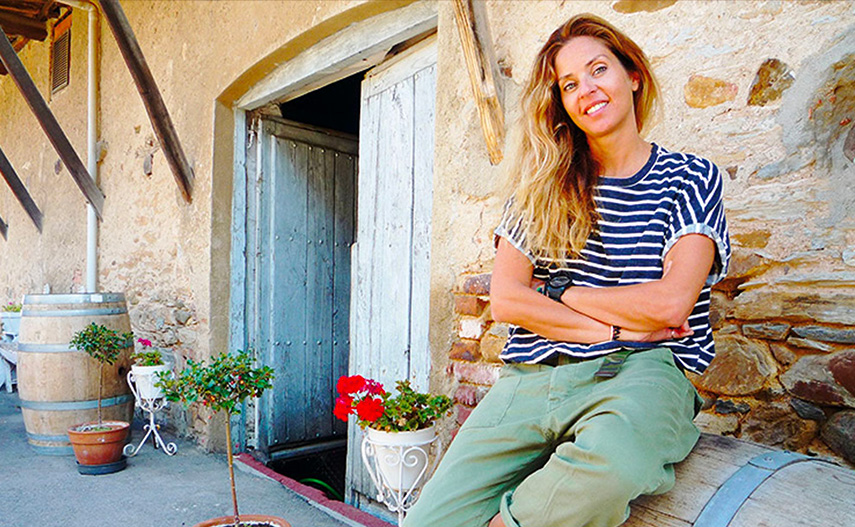
Verónica Ortega, daughter of the great Spanish bullfighter Rafael Ortega, remembered and recognised for the purity and honesty of his bullfighting, could not have been given a better name. We also admire Veronica and recognise the purity and honesty of her wines. This young Andalusian is one of the most promising winemakers on the world wine scene. She proudly carries the blood of a bullfighter in her veins and, without knowing it, she pays tribute to her father in everything she does. Without thinking twice, she “took the bull by the horns” and launched into the adventure of making some of the most vibrant and fine wines in Castilla y León (Spain). Let’s learn a little more about Verónica Ortega, the Andalusian winemaker who loves Mencía and El Bierzo.
- Verónica, you were born in Cádiz (Andalusia), where the wines of the Marco de Jerez, flamenco and bullfighting all come together. Do you have any childhood memories relating to wine at home? Or was it later that you became interested in wine and its world?
It is true that the image of sherry is everywhere you look in Cádiz. At home, when I was a child, whenever there was a celebration there was always a wine glass in hand. I didn’t grow up in a house with a great wine culture, though. It was later, after studying oenology, during my first harvest in the Priorat region that my interest in wine awakened.
- Your father was Rafael Ortega, an admired Spanish bullfighter and a great role model for you. Despite not being part of a family with deep winemaking roots, what would you say is the part of your father’s legacy that is still influencing your personal and professional life today?
My father was a man of great principles. He was deeply in love with his profession, the countryside and his family. From him I inherited a love of the countryside, and something that I consider to be very lucky; a passion or a vocation that makes all my efforts worth it.
- After studying oenology, you were fortunate enough to experience your first vintage in the Priorat, under the guidance of Álvaro Palacios and Daphne Glorian. Was the experience of working in the vineyard definitive? What did you find in Priorat or in the vineyard?
When I arrived in Priorat I had just finished my studies in oenology, but it was undoubtedly working with them that filled me with a huge desire to learn, to travel and work in different places and to train myself to work like they did, with total dedication and emotion.
- After working in a temple of wine like Domaine de la Romanée-Conti and with the option of making your own wines anywhere in the world, what made you come back to Spain? And why did you choose El Bierzo, when many dream of making wine in Marco de Jerez, your homeland?
My years outside Spain were wonderful, but my dream was always to return to Spain one day and establish myself as a winemaker, I dreamed of making my own wines and building my own project from scratch... Bierzo was the place I chose for the many qualities I found in the region: its very old vineyards, its climate, its deeply rooted and popular wine culture, but most importantly for the profile of its wines, that was what really made it clear to me when I decided to settle here.
Cádiz and its sherries is another thing, which I hope I might be able to get involved in one day, maybe when I retire, even if just for pleasure, I will have one little solera of old amontillado…
- In Bierzo, this modest area of Castilla y León, a wine revolution is taking place that places the denomination of origin on a par with the world’s great wine regions. What do you think is the secret of its success?
Well, I think that in Spain there are generally several areas recognised on the international wine scene for the quality of their wines and the stance they are taking... In Bierzo there are several factors that undoubtedly help to make it one of the most dynamic areas. A great wealth of vineyards and a good approach have been key to this revolution.
- According to the D.O. Bierzo, there are 9 wineries in Valtuille de Abajo, including yours, sharing territory with 101 inhabitants (according to the 2022 census data). Many of them are elderly people who have been working in their vineyards for generations. What was it like arriving here? Did you face many difficulties or did they make your life easier?
I always had help during my early days in Bierzo, not only in Valtuille, but also in other wineries where I vinified, bottled or rented spaces before having my own. For many, it was surprising that I came alone and dedicated myself to wine!
I have so many stories!
- Arriving in a place where the practice of viticulture is so deeply rooted and where they use techniques that have been passed down from generation to generation must be a challenge for someone who likes to learn from tradition, but with cutting-edge knowledge. What was it like for a young woman to start trying to implement new work patterns that winegrowers weren’t used to?
One of the great things about Bierzo is its winegrowers, who have maintained this vineyard, taking care of it for more than a century, they understand their land better than anyone, while also being open and willing to do things well.
- And what about you, what have you been able to learn from them that school or your experiences in other wineries hadn’t taught you?
Each site has its own vine growers because they face different challenges or struggles. In Bierzo there is also a very popular custom of making wine at home for one’s own consumption and the winegrowers tell you about methods they used to use in the family cellar, which they probably won’t show you in any winery, with surprising results!
- What can you tell us about the Mencía variety, a grape that is still unknown to many, but which has captivated you? What is it about its wines that you’ve fallen in love with?
It is a noble variety that, when well worked, can produce wines of incredible finesse, complexity and balance. It is a very transparent grape, for better or worse.
- What do you think is your personal contribution to Bierzo wines and how would you describe them for someone who doesn’t know them yet?
For better or worse, mine is a very personal interpretation of the area, the Mencía and the different profiles of Bierzo.
- Cal was one of your flagship wines, an extraordinary white wine made with the Godello variety that came from a very special plot and is no longer produced. What happened? How are you coping with the loss?
Cal was a wine with a very special profile that was made with an estate we no longer work, with a calcareous soil, which as you know, is very rare in Bierzo. But I’m very happy because following that version we have found another Godello vineyard which we are using to make Tormenta and it maintains that very mineral and sharp profile that the soil gives it, and we are also planting Godello in this area that interprets the variety so well.
- With so much work, do you have any free time? What do you like to spend it doing?
Not very much. I love the sea, and it’s what I miss the most. If I have free time I escape to Galicia, where I feel at home.