


 Red wine
 White wine
 Rosé wine
 Wines in Primeur
 Sherry and Port wine
 Sweet wine
 Orange wine
 Vermouth
 Champagne
 Cava
Cava Prosecco
 Lambrusco
 Crémant
 Moscato d'Asti
 Franciacorta
 Pet-Nat
 Corpinnat
 Other sparkling wines
 Rhum
Rhum Gin
Gin Whisky
 Vodka
Vodka Cognac
 Brandy
 Pastis
 Tequila
 Mezcal
 Grappa and Eau de vie
 Calvados
 Liqueurs
 Pacharán
 Apéritifs
 Wine gift boxes
 Boxed wines
 Boxed sparkling wines
 Wine bottles and glasses
 Gift card
 Non alcoholic Wine
 Non alcoholic Sparkling wine
 Aromas
 Wine conservation
 Decanters and aerators
 Bottle identifiers
 Corkscrews
 Service
 Glass identifiers
 Cleaners
 Accessories set
 Wine glasses
 Contact

El Bierzo, its people, its landscapes, and its vineyards.
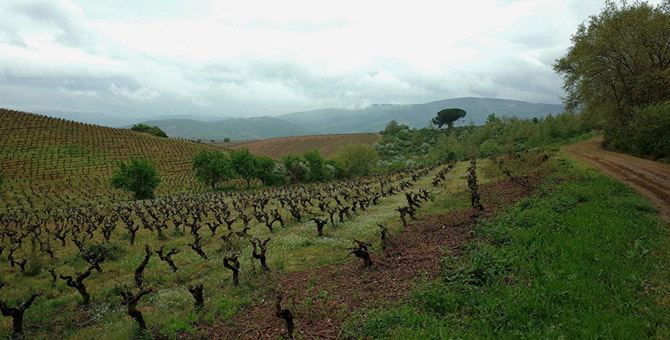
El Bierzo is not just a region; it is a state of mind. When you cross the Manzanal mountain pass, time slows down, and suddenly your pace of life relaxes. It is a unique region, formed by countless landscapes, different villages, old vineyards planted in the traditional goblet style, mountains, forests, and endless rivers. We have been there, visiting some of the winemakers in the area, trying to learn more about the wines of the Bierzo Designation of Origin.
With a glass in hand, we tasted all the wines they had in different tanks. We started with the stainless steel tanks where they produce Brezo wines (white and red), wines with a fruity and drinkable character. Then, we moved on to the large oak foudres where they make Mengoba wines, with much more complexity but without losing balance.
We ended with their two new cuvées, Mengoba Tinajas and Mengoba Las Botas, where they show their eagerness to continue investing in the region and discover the new opportunities that different tanks, such as clay amphorae and sherry butts, can offer. We were pleasantly surprised by the myriad of aromas of white flowers and citrus in a Godello wine that ferments and macerates with its skins for approximately seven months in clay amphorae. On the palate, there is no perception of the tannins that the skins and grape seeds can impart. The sherry butts provide a special tension and finesse to the Godello grape for its wine.
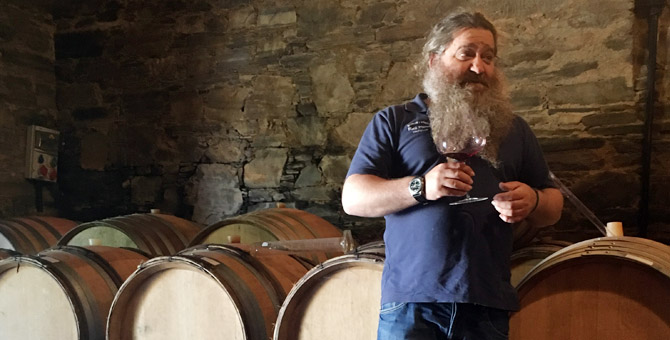
We are very grateful to have been able to spend a few hours with Gregory, for his contagious smile and his desire to continue evolving in the area. With each passing year, his wines become greater.
And now, it's time to discover Raúl Pérez's wines...
After finishing the visit with Gregory, we had to hurry to reach Valtuille de Abajo to meet one of the people who has put the Bierzo region, specifically Valtuille, on the world map of great wines: Raúl Pérez. Raúl was waiting for us in his winery, La Vizcaína, where he greeted us naturally and invited us to accompany him to the Ponferrada area of Valdecañadas, where he has some of his vineyards and another winery.
On the way, we toured all of Valtuille while Raúl explained the characteristics of the various vineyards with different exposures and soils, some of which are becoming well-known names, such as Rapolao or Las Guindiñas. Raúl's idea is to dignify the different subzones of Valtuille so that each winemaker can interpret them in their own way, but always knowing where the grapes come from.
In the past, the grapes from the vineyards in the Valdecañadas area were sold to the cooperative, but for various reasons, they were gradually abandoned. Raúl, as a visionary, started buying vineyards that he found attractive in order to vinify them separately in the Cabildo de las Salas winery, a village near the vineyards. The main characteristic of this area, unlike Valtuille, is that the soils are slate and the altitude is higher, around 600/700 meters.

While Raúl explained the history of wine and the Bierzo region in great detail, he showed us his new vineyard, from which he will produce the new wine, Cara Norte. Then, along the slope, we reached a small plot called Petra, from which only 500 bottles were produced in two vintages, 2011 and 2013. It is a beautiful half-hectare vineyard from which all the vineyards exposed to the valley can be seen, as if it were an immense amphitheater.

We descended to the old winery, built in 1819 for wine production by the diocesan authority, where Raúl produces his wines under the Ultreia brand. It is a magnificent and magical winery where he makes all his wines using a unique minimal intervention process. According to him, it is a perfect place for the wines to age, as a flor layer forms and protects them until bottling. This is his peculiar philosophy of not topping up barrels. We tasted the barrels and noticed the differences between Valtuille and the vineyards in the Ponferrada area—completely different textures that magnify the sense of the terroir within the Bierzo region.
Corullón...
Another great area of the Bierzo that we had to visit was Corullón. It was there that Ricardo Pérez Palacios "Titin" and his uncle Álvaro Palacios settled in 1999.
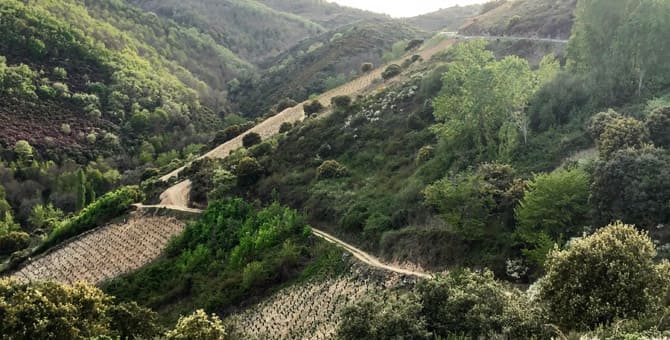
To the southwest of Villafranca del Bierzo and crossing the Burbia River lies the town of Corullón. It is one of the most rugged and impressive landscapes in the Bierzo region, with its steep slopes that are impossible to work with tractors and challenging for humans, only able to be cultivated with animal traction. Many vineyards were abandoned due to this inconvenience, but Ricardo and the wines of Descendientes de J. Palacios will be discussed in detail later.