



 Red wine
 White wine
 Rosé wine
 Wines in Primeur
 Sherry and Port wine
 Sweet wine
 Orange wine
 Vermouth
 Champagne
 Cava
Cava Prosecco
 Lambrusco
 Crémant
 Moscato d'Asti
 Franciacorta
 Pet-Nat
 Corpinnat
 Other sparkling wines
 Rhum
Rhum Gin
Gin Whisky
 Vodka
Vodka Cognac
 Brandy
 Pastis
 Tequila
 Mezcal
 Grappa and Eau de vie
 Calvados
 Liqueurs
 Pacharán
 Apéritifs
 Wine gift boxes
 Boxed wines
 Boxed sparkling wines
 Wine bottles and glasses
 Gift card
 Non alcoholic Wine
 Non alcoholic Sparkling wine
 Aromas
 Wine conservation
 Decanters and aerators
 Bottle identifiers
 Corkscrews
 Service
 Glass identifiers
 Cleaners
 Accessories set
 Wine glasses
 Contact

At what temperature should wine be served? The precise point at which the wine reveals its character.
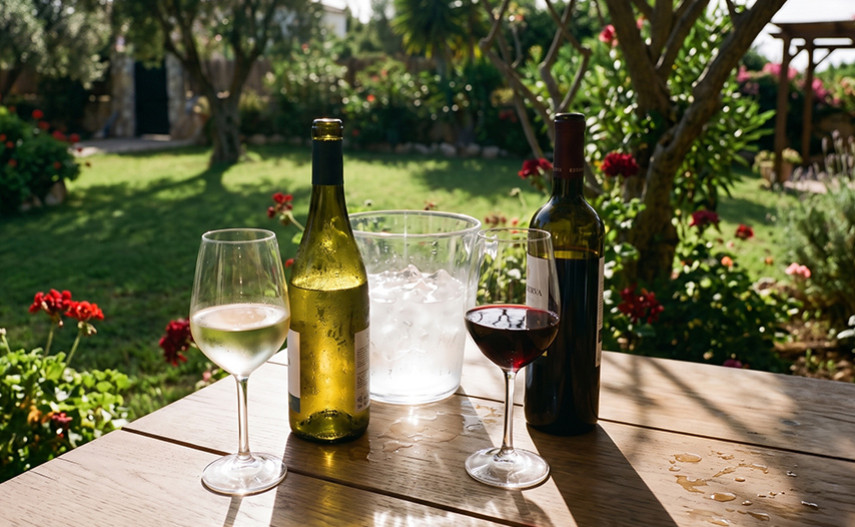
Surely, at some point, you've thought that a wine "didn't say much" or that only the alcohol was noticeable. Before blaming the bottle, there might be another culprit. Serving a wine too cold or too warm can completely alter what's in the glass: from the aromas you perceive to the texture you feel on the palate. Would you like to know the ideal serving temperature for each type of wine?
Let's begin at the start. To fully comprehend, it is essential to consider that wine is composed of aromatic molecules that are released and travel through the air to our nose. These molecules, technically referred to as volatile aromatic compounds, are dispersed within the wine and come in various types. Firstly, there are those that originate directly from the grape, known as varietal aromas, which include terpenes (aromas of roses, orange blossom, lemon), pyrazines (green pepper, fresh grass) or volatile thiols (passion fruit, mango, grapefruit). Secondly, there are aromas derived from fermentation, where esters (apple, banana, pear) and higher alcohols (which sometimes contribute to that sensation of sweetness and warmth in the wine) are prominent. Lastly, there are aromas derived from ageing or maturation, which are imparted directly by the barrel or container, by oxygen, and by time. Here, vanilla, lactones (which provide the famous coconut notes), and aldehydes, very present in fortified wines, which give those characteristic nutty or bakery notes, stand out.
Well then. Once we know what is in the glass, it is time to understand how temperature influences these compounds. Primarily, it is important to note that, depending on the temperature, the rate at which these aromas are released from the wine will also vary. This is known as volatilisation, which is the transition from liquid to air. The higher the temperature, the more molecular movement and, consequently, greater evaporation.
Wine too cold. What happens?
When the liquid is served cold, the molecules move very little. This results in a very low volatility, meaning that not many aromas reach us. As a result, the wine will be much more closed, muted, almost flat, without revealing all the nuances it conceals. Has this never happened to you?
And something very similar occurs on the palate, as the increase in cold also enhances the sensation of freshness, which ultimately reduces sweetness and heightens the perception of acidity. It's not that your wine is more acidic when chilled; it's that you perceive it that way.
And a wine too warm?
In the opposite scenario, where the wine is too warm, the molecules will have excessively high volatility, highlighting first those molecules with a higher degree of volatility, such as alcohol. Have you never experienced only being able to smell and taste the alcohol in some wines? This is because alcohol is the most volatile compound, masking all others, including the more delicate aromas.
And what happens on the palate?
Evidently, temperature also alters the tactile sensation experienced when tasting our wine (it is important to remember that the sense of touch also plays a role on the tongue when tasting wine).
When a wine is served too cold, the tannins become more astringent, with a drier sensation, almost more bitter. Conversely, when served at a warmer temperature, these compounds appear more rounded and better integrated.
The ideal temperature
As you might have guessed, each wine has its perfect aromatic window, where volatile compounds and tannins can express themselves in all their glory.
For instance, the wines served the coldest are sparkling wines, typically enjoyed at a temperature between 6-8 °C, as the cold helps maintain the bubble's tension and acidity. But beware! Much colder, and sparkling wines become completely mute and flat.
Next would be the lighter and younger white wines, also served cold, between 8-10 °C, ensuring they retain their freshness and aromatic expression, without losing vibrancy, leaving the alcohol in the background. The situation changes with full-bodied and aged whites, where the temperature would rise to 10-12°C. This allows these wines, which are much more complex, to reveal their ageing notes.
Following them would be the young red wines, served between 12-14 °C, kept slightly cool to highlight their fruit and avoid that alcoholic sensation (especially in summer). As with whites, the situation varies with aged reds, more structured, where the temperature rises between 14-18 °C. The aim of this increase is to soften the tannins, achieving a balance of all the aromas (including those derived from ageing), without the alcohol dominating the tasting experience.
Lastly, fortified wines deserve a special mention, one of the broadest ranges in the cellar, where the temperature varies between 8-14 °C. The driest and sharpest (such as finos and manzanillas) should be served cold, while the more complex ones—usually amontillados, olorosos, and palos cortados from oxidative ageing—should be served warmer, enhancing all the aromas they conceal.
In case of doubt, remember a simple rule: better a wine slightly cooler than too warm. You can always warm it up a few degrees in the glass, but you cannot recover a wine that has exceeded its temperature. Finding that precise point is not a technical matter, but the key to allowing each wine to express itself as intended.